Abby: Evaluating the Quirky Monster Character Font for Your Next Project
Understanding the Core Concept: A Font as a Cast of Characters
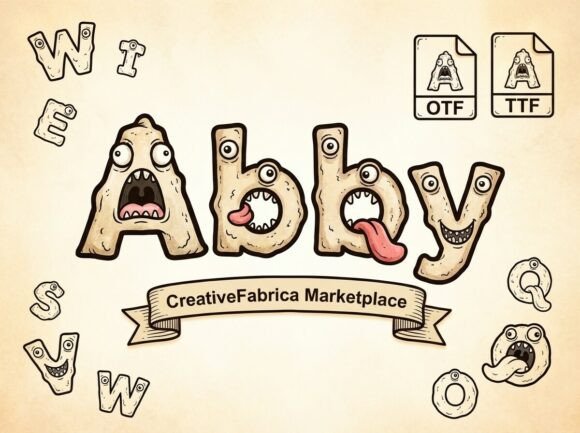
In the search for the perfect display typeface, the choice often comes down to personality versus legibility. Abby, a monstrously creative display font, sits firmly on the side of unbridled personality. It is not merely a set of letters with a specific weight or serif style; it is a collection of individual characters, each a living, breathing creature. The design features wide, expressive eyes, sharp teeth, and long, wagging tongues integrated into the letterforms. This creates a hand-drawn, goofy energy that transforms standard text into a playful narrative before the words are even read. For designers and creators, understanding Abby means recognizing it as an illustration set as much as a typographic tool.
The font's distinctiveness lies in its approach to each glyph. A capital 'A' might have its crossbar formed by a creature's grinning mouth, while a lowercase 'b' could have eyes peering from the bowl. This level of detailed, character-driven design means that every word composed in Abby becomes a small scene. This is a significant departure from traditional display fonts that rely on uniform stylistic quirks—like rounded edges or geometric cuts—to establish a mood. With Abby, the mood is inherent in the creature's expression, offering a direct, visual storytelling mechanism.
Comparing Abby to Other Playful and Display Font Categories
When evaluating font options, it is helpful to place Abby within the broader landscape of playful and decorative typography. It occupies a specific niche that differs from several common alternatives.
- Versus Standard "Fun" or "Rounded" Fonts: Fonts like Comic Sans or Bubblegum Sans use soft, rounded shapes and informal strokes to convey a friendly, approachable tone. They are legible at smaller sizes and work well for body text in casual contexts. Abby, by contrast, sacrifices this versatility for high-impact character. Its detailed illustrations become muddled at small sizes, making it unsuitable for paragraphs but exceptional for headlines where every letter can be appreciated.
- Versus Decorative or Themed Fonts: A font styled after woodblock printing or Art Deco achieves its effect through consistent geometric or historical patterns. The "theme" is in the style, not in each letter being a unique pictograph. Abby’s theme is literal and narrative—the monsters themselves. This makes it more of a specialized graphic asset than a general-purpose typeface.
- Versus Dingbat or Pictorial Fonts: Some fonts use letter keys to output small icons or symbols. While Abby's characters are pictorial, they remain fully functional letters of the alphabet. This is a critical distinction: you can type coherent words and sentences, and the meaning is preserved through the letterforms, not just the imagery. The challenge and strength lie in the fact that the imagery is the letterform.
Key Strengths and Inherent Tradeoffs
Abby’s primary strength is its immediate, high-energy engagement. It is designed to elicit a smile and capture attention instantly. This makes it particularly effective for projects where the goal is to create a sense of fun, whimsy, or spooky playfulness. The hand-drawn quality avoids looking sterile or overly digital, adding a tactile, crafted feel to designs.
However, this strength comes with inherent tradeoffs that are crucial to consider during the evaluation process:
- Legibility at Scale: The very details that make Abby charming—tongues, teeth, varied eye positions—can reduce clarity, especially in all-caps settings or when viewed from a distance. Testing the font at the intended output size is non-negotiable.
- Contextual Limitation: Its strong thematic identity limits its versatility. Using Abby for a corporate report or a serious news headline would be jarring and inappropriate. Its utility is confined to contexts where its playful, monstrous aesthetic aligns with the project's tone.
- Typographic Hierarchy: Because Abby is so visually dominant, it can overwhelm other design elements. Pairing it with a simple, clean sans-serif or serif font for supporting text is essential to maintain balance and ensure the main message isn't lost in the visual noise.
Best-Fit Applications: When to Choose Abby
Determining if Abby is the right resource involves matching its unique strengths to specific project requirements. It excels in scenarios where the text itself needs to be a focal point of the visual design.
Children’s Book Titles and Chapter Headings: This is a natural fit. The font does much of the illustrative work, setting a tone of adventure and imagination. A title like "The Midnight Zoo" set in Abby immediately tells a young reader what kind of story to expect.
Themed Event Decor and Invitations: For Halloween parties, monster-themed birthdays, or school carnival promotions, Abby provides built-in decor. Invitations, banners, and signage can achieve a cohesive, custom-illustrated look without commissioning separate artwork for each letter.
Playful Packaging and Product Design: Toy packaging, cereal boxes for kids, or branding for a line of quirky snacks can leverage Abby's character to stand out on shelves. It communicates that the product inside is meant to be fun and engaging.
Digital Content and Social Media Graphics: Thumbnails, video titles, and promotional graphics for YouTube channels or blogs focused on family content, animation, or gaming can use Abby to establish a recognizable and entertaining brand personality quickly.
Decision Factors and Practical Considerations
Before finalizing a choice, several practical factors should guide your evaluation of Abby and similar character-driven fonts.
- Project Scope and Audience: Is the audience children, families, or adults seeking nostalgia? The font's effectiveness is directly tied to audience reception. For a broader or more professional audience, a subtler playful font might be safer.
- Output Medium: Will the text be printed large on a poster or viewed as a small icon on a website? Abby's details demand larger renderings. If the primary use is digital at small sizes, its impact will be lost.
- Longevity of Use: Is this for a one-time event or a long-term brand identity? A highly specific font like Abby can become dated or lose its novelty if overused. It might be best reserved for seasonal or campaign-specific materials rather than a permanent logo.
- Licensing and Technical Format: As with any font resource, verify the licensing agreement to ensure it covers your intended use (commercial vs. personal, number of users, etc.). Also, confirm the file format (OTF, TTF, WOFF) is compatible with your design software.
Ultimately, Abby is a specialized tool in a designer's toolkit. It is not a replacement for versatile workhorse fonts but a solution for when a project calls for a specific, character-driven aesthetic. Its value lies in its ability to inject instant personality and narrative into typography. When the brief is to "make it fun, make it monstrous, and make it memorable," Abby presents a compelling and creatively rich option worth serious consideration. For projects requiring broader application or more subdued professionalism, exploring other display font categories would be a more prudent path.