School Rules: The Essential Sans Serif Font for Modern Design
In the vast landscape of digital typography, finding a font that balances neutrality with personality is a significant challenge. Many designers seek a typeface that does not scream for attention but rather supports the content with quiet confidence. This is where School Rules enters the conversation. As a minimal and neat sans serif font, it offers a solution for projects that require clarity, professionalism, and a touch of contemporary edge. Understanding how to leverage this specific typography can be the difference between a project that feels generic and one that feels intentionally crafted.
Understanding the Core of School Rules
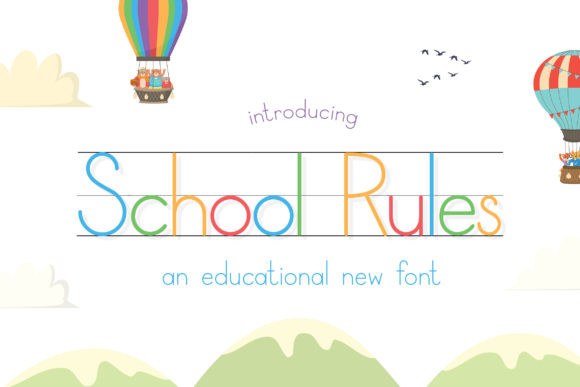
At its heart, School Rules is defined by its simplicity. It strips away the ornamental flourishes found in serif fonts or the aggressive geometry of some display typefaces. Instead, it focuses on clean lines and consistent spacing. This minimalism is not a lack of character; rather, it is a deliberate design choice that prioritizes readability. The "neat" quality of the font ensures that text blocks look organized and structured, which is crucial for user experience in both print and digital mediums.
For the adult professional—whether a graphic designer, a marketing manager, or a small business owner—this font represents reliability. It is the typographic equivalent of a well-tailored business suit: appropriate for almost any occasion, always looking sharp, and never distracting from the message being delivered. When you choose School Rules, you are choosing a tool that adapts to your content rather than forcing your content to adapt to it.
The Challenge: Finding Versatility in a Crowded Market
One of the most common frustrations in creative work is the "mismatch" problem. A font might look beautiful in a logo mockup but becomes unreadable when applied to a website’s body text. Alternatively, a font optimized for long-form reading might look boring on a poster or social media graphic. Creatives often find themselves swapping between dozens of font families to find one that works across different contexts.
The goal for many projects is cohesion. You want the branding on a mobile app to feel connected to the printed brochure and the signage in a physical office. School Rules addresses this need for unity. Because it is designed to be matched to an incredibly large set of projects, it acts as a bridge between different design elements. It solves the problem of visual fragmentation by providing a consistent visual voice that remains legible and stylish regardless of the medium.
Practical Applications and Implementation
The true value of School Rules is revealed in its application. Its versatility allows it to function effectively in various roles, from headings to body copy. However, to maximize its potential, users should consider the context of their specific project.
Digital Interfaces and Web Design
In the realm of UI/UX design, legibility is paramount. Users scan screens quickly, and complex fonts often cause cognitive friction. School Rules excels here because of its open letterforms and distinct characters. It reduces the likelihood of confusing similar letters (like lowercase 'l' and 'I'). When implementing this font for web use, it pairs exceptionally well with high-contrast backgrounds. It provides a modern, tech-forward aesthetic that suits SaaS dashboards, corporate landing pages, and e-commerce platforms alike.
Editorial and Print Design
For print materials such as magazines, annual reports, or flyers, School Rules offers a clean canvas. It allows imagery and headlines to take center stage while ensuring the supporting text is easy to digest. In editorial layouts, a minimal sans serif helps create a sense of white space and airiness, making dense information feel less overwhelming. It is particularly useful for captions, footnotes, and pull quotes where space is limited but clarity is non-negotiable.
Branding and Identity
When building a brand identity, the typography must reflect the company's values. If a brand aims to appear approachable, transparent, and modern, School Rules is an excellent candidate. It avoids the cold, sterile feeling of some corporate fonts while steering clear of the playful chaos of handwritten styles. It strikes a balance that appeals to a broad demographic, making it suitable for industries ranging from education and healthcare to finance and retail.
Different Approaches for Different Users
Not every user approaches a font in the same way, and School Rules accommodates various workflows.
The Corporate Professional: For someone creating internal reports or presentations, the priority is professionalism and ease of reading. They might use School Rules in standard weights (Regular or Medium) to ensure that dense paragraphs of data are accessible to stakeholders without eye strain. The focus here is on the font's "invisible" quality—it does its job without drawing attention to itself.
The Creative Designer: A graphic designer working on a poster or a social media campaign might utilize the bolder weights of School Rules. By increasing the size and utilizing the font's neat geometry, they can create striking headlines that feel contemporary. They might experiment with letter spacing (tracking) to give the text a more airy, high-fashion look, proving that a "minimal" font can still be a focal point.
The Educator or Administrator: Given its name and style, School Rules is naturally suited for educational materials. Teachers creating worksheets or school administrators designing newsletters will find the font highly functional. Its clarity aids in learning environments where readability can impact comprehension and retention.
Recommendations for Getting the Most Out of School Rules
To truly make your creative ideas stand out with School Rules, consider the following practical tips:
- Embrace White Space: Because the font is minimal, it thrives when given room to breathe. Avoid cramming text too tightly together. Generous line height and margins will enhance the "neat" aesthetic of the typeface.
- Pairing Strategies: While School Rules can stand alone, it pairs beautifully with serif fonts for contrast. Using a serif for main headings and School Rules for body text (or vice versa) creates a dynamic visual hierarchy that guides the reader's eye.
- Color and Contrast: This font looks exceptional in monochromatic color schemes—black text on white, or white text on dark backgrounds. However, because of its clean structure, it can also handle brand colors well without looking muddy or cluttered.
- Hierarchy through Weight: Utilize the different weights available (Light, Regular, Bold) to create structure. A light weight can feel airy and elegant for subtitles, while a bold weight provides authority for key takeaways.
The Outcome: Standing Out by Fitting In
It may seem counterintuitive, but one of the best ways to make a design stand out is to use typography that fits the content perfectly. When a viewer looks at a design using School Rules, they may not immediately notice the font—but they will notice that the design feels polished, professional, and easy to understand. That is the hallmark of good typography.
By choosing School Rules, you are investing in a design asset that grows with your ideas. It is a font that does not impose a heavy stylistic footprint, allowing your actual content—your words, your images, and your message—to shine. Whether you are designing a complex user interface or a simple business card, this font provides the foundation you need to create something that is both functional and aesthetically pleasing.