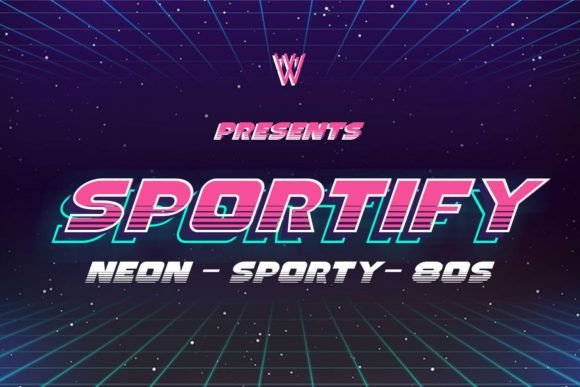
The Anatomy of Sportify: Merging Athleticism with Cyberpunk Typography
In the realm of visual communication, typography is rarely just about legibility; it is about evocation. The Sportify typeface stands as a testament to this principle, serving as a bridge between the gritty, high-energy world of athletics and the neon-soaked aesthetic of 1980s retrofuturism. To understand the utility of Sportify, one must look beyond the mere arrangement of letters and analyze the design philosophy that drives it. It is a font that does not merely sit on a page; it occupies space with a distinct, semi-modern cyberpunk attitude, making it a subject of interest for designers, marketers, and brand strategists alike.
Deconstructing the Visual DNA
The core appeal of Sportify lies in its deliberate construction. It is not a standard sans-serif or a simple geometric font. Instead, it utilizes a "thick" stroke width, a characteristic that immediately signals weight, importance, and presence. This thickness is not accidental; it is a functional choice designed to ensure readability in high-contrast environments, such as stadium jumbotrons or fast-moving digital interfaces. However, the most defining feature of the typeface is its integration of font gradation. Unlike a flat, solid color, this gradation creates a sense of motion and depth, simulating the look of speed lines or digital data flow.
The Role of Thickness in Product Display
When analyzing the font's application in product thumbnails, the thickness plays a critical psychological role. In the context of sports merchandise—jerseys, running shoes, or performance gear—thin, delicate typography often gets lost. Sportify commands attention. The heavy weight of the letterforms ensures that the text remains the focal point even when competing with high-resolution imagery of the products themselves. This makes the font particularly effective for e-commerce headers and sale banners where immediate impact is required.
The Cyberpunk and Retro Synthesis
The aesthetic lineage of Sportify draws heavily from the cultural shifts of the 1980s. This era was defined by a fascination with the future, often interpreted through neon colors, grid patterns, and a sense of digital rebellion. Sportify taps into this "Neon" and "Retro" vibe without becoming a caricature. It manages to feel "semi-modern," suggesting that while the roots are vintage, the application is forward-thinking.
This synthesis is particularly relevant in today's market, where nostalgia is a powerful marketing tool. However, a purely retro font can feel dated. By blending these 80s elements with a cyberpunk edge, Sportify achieves a timeless quality. It feels at home on a vintage arcade cabinet as it does on a futuristic smartwatch interface. For creators and business owners, this duality offers a unique opportunity to appeal to multiple demographics simultaneously—those seeking the comfort of the past and those looking toward the future.
Practical Applications and Industry Relevance
The versatility of Sportify extends across various industries, though its primary stronghold remains the sports and entertainment sectors. The font is engineered for "display" purposes, meaning it excels in headlines, logos, and branding rather than long-form body text. Its aggressive geometry makes it suitable for:
- Esports Branding: The cyberpunk undertones align perfectly with the gaming and esports industry, where futuristic aesthetics are standard.
- Athletic Apparel: As noted in thumbnail previews, the font complements the texture and form of sports gear, reinforcing the idea of performance and durability.
- Event Promotions: For concerts, festivals, or marathons, the neon gradation effect captures the high-energy atmosphere of live events.
- User Interface (UI) Design: In app design, particularly for fitness trackers or music streaming platforms, Sportify can be used for headers to guide the user's eye to critical data points.
Workflow Integration for Designers
For graphic designers and researchers studying visual trends, Sportify represents a shift toward dynamic typography. In a typical design workflow, static fonts are often layered with effects to achieve movement. Sportify streamlines this process by embedding the "sporty impression" directly into the font file through its gradation. This reduces the post-processing time required to make text "pop," allowing for a more efficient workflow. It is a practical solution for creators who need to produce high-volume content, such as social media posts for a sports team, without sacrificing quality.
The Psychology of the "Sporty" Impression
Why does the gradation in Sportify work so effectively to convey athleticism? The answer lies in the psychology of motion. Humans are wired to interpret gradients as indicators of depth and movement. In nature, shadows and highlights define the shape of an object; in digital design, gradients simulate this 3D reality. When applied to typography, a vertical or horizontal gradation—moving from a solid base to a lighter tone or a neon hue—mimics the blur of motion.
This visual trickery is essential for sports branding. The industry is built on the concept of kinetic energy—running, jumping, scoring. A static, flat font can feel stagnant. By using Sportify, a designer injects a sense of velocity into the text itself. It suggests that the brand is active, modern, and always moving forward. This is a subtle but powerful way to influence consumer perception without using a single word of copy.
Considerations for Implementation
While the characteristics of Sportify make it a potent tool, it requires careful handling. Its distinct style—thick, gradiated, and retro-futuristic—can easily overwhelm a design if not balanced correctly.
- Contrast is Key: Because the font has a strong personality, it pairs best with clean, minimalist sans-serif fonts for body text. Using another stylized font alongside Sportify can create visual clutter.
- Color Palette: The neon and cyberpunk elements suggest a palette of high-saturation colors—electric blues, magentas, and cyans—against dark backgrounds. However, it can also be effective in monochromatic schemes (black and white) for a more aggressive, industrial look.
- Scalability: As a display font, Sportify performs best at larger sizes. At very small point sizes, the gradation details and thick strokes may merge, reducing legibility. It is best reserved for headers and logos.
Target Audience Analysis
The utility of Sportify is not limited to designers. Educators in design schools might use it as a case study to explain how typography can reflect cultural eras (the 80s) and subcultures (cyberpunk). Hobbyists interested in retro computing or synth-wave music production might find the font ideal for album art or merchandise. For business owners, particularly those launching a startup in the fitness tech or streetwear space, adopting a typeface like Sportify can instantly establish a brand identity that feels established and culturally aware.
Observations on Typography Trends
The emergence of fonts like Sportify signals a broader trend in the design world: the blurring of lines between physical and digital aesthetics. We are seeing a move away from the ultra-clean, "flat" design that dominated the 2010s toward something more textured, volumetric, and expressive. The "retro" label is no longer just about looking old; it is about reinterpreting historical optimism through a modern lens.
Furthermore, the specific mention of "thumbnails" in the context of Sportify highlights the importance of the medium. In an era dominated by video content and scrolling feeds, the thumbnail is the new billboard. Fonts must be optimized for these small, fleeting windows of attention. The boldness and internal energy of Sportify make it perfectly suited for this micro-format, ensuring that the message is communicated in the fraction of a second it takes to scroll past.
Conclusion
Sportify is more than just a collection of glyphs; it is a visual language that speaks to the intersection of sport, technology, and nostalgia. Its thickness, gradation, and stylistic lineage make it a specialized tool for specific, high-impact applications. Whether used on the side of a sneaker box, the header of a gaming tournament, or the splash screen of a fitness app, the font delivers a distinct message of energy and modernity. For the professional seeking to understand the evolution of display typography, Sportify offers a compelling study in how design can capture the essence of motion and culture.