The Art of Absence: Deconstructing the Utility and Aesthetics of the Babet Font
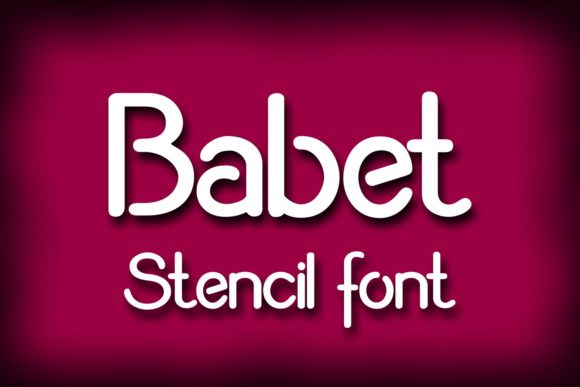
In the intricate world of typography, the most defining features of a typeface are often found not in the lines and curves that are present, but in the negative space they create. For centuries, typographers have experimented with the boundaries of legibility and form, seeking designs that balance artistic expression with functional clarity. One of the most fascinating explorations in this realm is the stencil aesthetic—a style defined by strategic interruptions. The Babet font stands as a modern testament to this tradition. It is a carefully crafted stencil font distinguished by its unique construction: it features no closed loops on its characters. This specific design choice transforms the font from a mere text utility into a powerful tool for visual communication, bridging the gap between industrial ruggedness and sophisticated minimalism.
Anatomy of the "Open" Form
To truly appreciate Babet, one must first understand the structural engineering behind its letterforms. Most traditional typefaces rely on closed counters—the enclosed spaces found in letters like 'o', 'b', 'd', 'e', and 'g'. In standard fonts, these counters are essential for instant recognition. However, Babet challenges this convention by removing these enclosures entirely.
In typography, a "closed loop" implies a continuous perimeter. By eliminating these, Babet introduces a level of visual permeability. The letters appear as if they are constructed from a single, unbroken thread that loops around but never fully closes, or as if they have been stenciled where ink would be trapped. This creates an "open" aesthetic. The result is a typeface that feels airy and lightweight, regardless of its weight or size. This absence of closure forces the viewer's eye to engage more actively with the text, mentally bridging the gaps to complete the letterforms. This phenomenon, known as gestalt closure, makes Babet particularly engaging for display text where capturing attention is paramount.
The Psychology of Stencil Typography
Why does a stencil font resonate so deeply with modern audiences? The psychology behind typography suggests that fonts carry specific connotations. Traditional stencils are associated with shipping crates, military equipment, and industrial manufacturing—environments that value durability, efficiency, and stark functionality.
Babet leverages this industrial heritage but refines it for a contemporary context. Unlike heavy, grungy stencil fonts often used to evoke war or urban decay, Babet offers a "carefully crafted" precision. It retains the ruggedness of the stencil style but cleans up the edges, making it suitable for high-end branding and editorial design. It suggests a brand that is honest, straightforward, and built on solid foundations, yet modern enough to appreciate minimalism. For a broad audience ranging from hobbyists to business owners, this duality is incredibly valuable. It allows a design to feel grounded and accessible without sacrificing elegance.
Practical Applications in Modern Design
The versatility of Babet extends across various platforms and media. Because of its lack of closed loops, it maintains high legibility even at smaller sizes or in lower resolutions, provided the "bridges" in the stencil are wide enough to prevent ink bleed—a crucial consideration for physical printing.
Branding and Identity
For startups and established businesses alike, Babet offers a distinctive voice. A tech company might use it to suggest "open-source" values or transparency, playing on the visual openness of the letters. A boutique fashion label could use it to evoke a sense of architectural structure. The font’s ability to avoid looking "generic" helps in creating a memorable logo that stands out in a crowded market.
Editorial and Web Design
In the digital space, where screen fatigue is a real concern, Babet can serve as an excellent typeface for headers and sub-headers. Its open structure allows light to pass through the text, reducing the visual density of a webpage. This makes the reading experience feel less strenuous. Educators and researchers presenting data can use Babet for slide titles to ensure that key points are visible from the back of a lecture hall, as the simplified forms are easier to parse from a distance.
Physical Manufacturing and Signage
True to its roots, Babet excels in physical applications where stenciling is required. This includes spray-painted murals, etched glass, laser-cut wood signage, and vinyl decals. Because the design inherently accounts for the absence of material (the "bridge" required to hold the center of an 'O' or 'D' in a physical stencil), using Babet for these projects saves designers the time-consuming task of manually adding bridges to a standard font. It is "print-ready" for physical fabrication.
Comparison with Traditional Serif and Sans-Serif Fonts
When selecting a typeface, designers often weigh the pros and cons of Serif (with decorative feet) versus Sans-Serif (without feet). Babet introduces a third category: the Structurally Modified Sans-Serif.
- Readability vs. Legibility: While a standard Serif font (like Times New Roman) is optimized for long-form reading (readability), Babet is optimized for quick recognition and impact (legibility). It is not recommended for body text in a novel, but it outperforms many standard fonts in headlines.
- Space Efficiency: Because of the open forms, Babet can sometimes appear wider than a condensed sans-serif, but the "air" within the letters allows for tighter kerning (spacing between letters) without the text feeling claustrophobic. This creates a unique rhythm in the text block.
- Personality: Standard sans-serifs like Helvetica aim for neutrality. Babet aims for character. It injects personality into a layout without the whimsicality of a script font or the severity of a blackletter.
Technical Considerations for Implementation
For creators and developers integrating Babet into their workflow, several technical factors must be considered to maximize the font's potential.
Weight and Contrast
Stencil fonts can sometimes suffer from low contrast against complex backgrounds. When using Babet over images, designers should ensure the text is placed over areas of low visual noise or use a semi-transparent overlay. The "stencil bridges" can sometimes be lost against high-contrast backgrounds, so testing the color pairing is essential.
Pairing Strategies
Babet pairs exceptionally well with neutral, highly legible body fonts. Because Babet is a display font with strong structural personality, it requires a "quiet" partner. A geometric sans-serif for the body text creates a modern, cohesive look. Conversely, pairing Babet with a classic Serif font can create a compelling contrast between industrial utility and academic tradition, a style often favored in editorial magazines.
OpenType Features and Alternates
High-quality crafted fonts like Babet often come with OpenType features. Users should explore the font family for stylistic alternates. Sometimes, a font includes a "closed" version of problematic letters for use in very specific contexts, or ligatures that smooth out the connection between stenciled letters. Understanding these features allows for more precise typographic control.
The Role of Negative Space in User Experience (UX)
In the context of User Interface (UI) design, the principles embodied by Babet align closely with modern design trends like "Flat Design" and "Bauhaus minimalism." These trends prioritize function and clarity over ornamentation.
The "holes" in Babet are not merely aesthetic quirks; they function as built-in whitespace. In UI design, whitespace (or negative space) is a critical component that helps group elements and guide the user's eye. By using a font that inherently contains more negative space, a designer can create a UI that feels more breathable and organized. This is particularly useful in mobile app design, where screen real estate is limited, and clarity is paramount. Babet allows for bold, large-scale typography on mobile interfaces without overwhelming the user.
Trends in Typography: Why "Open" Fonts are Rising
The design community is currently witnessing a resurgence of interest in brutalist and functional aesthetics. This trend is a reaction against the polished, glossy, and sometimes sterile look of "Corporate Memphis" illustrations and rounded sans-serifs that dominated the previous decade.
Babet fits perfectly into this new wave. It embraces the rawness of construction but executes it with high-fidelity craftsmanship. It signals a shift toward transparency in design—literally showing the "gaps" in the structure. For businesses aiming to rebrand in 2024 and beyond, adopting a typeface like Babet signals an alignment with contemporary design sensibilities and a willingness to break away from the status quo.
Conclusion
Babet is more than just a collection of characters; it is a study in structural integrity and visual efficiency. By removing the closed loops, it challenges the viewer to participate in the act of reading, creating a more engaging visual experience. Whether used by a hobbyist creating a custom t-shirt, a researcher designing a presentation, or a corporation rebranding its image, Babet offers a unique combination of industrial heritage and modern elegance. It proves that in typography, what is left out can be just as important as what is put in.